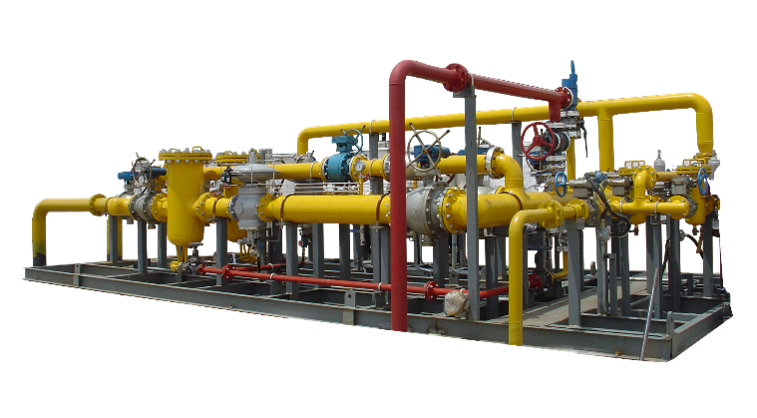
Natural gas pressure regulating and metering stations are key equipments in gas transmission pipelines. The main functions are regulate and stabilize system pressure, control the gas flow in the transmission system, and protect the system from excessively high or low outlet pressure.
During the process of gas transmission, pressure, flow, and safety controls need to be carried out according to the actual conditions at each stage. According to pressure levels, pressure regulation accuracy, and auxiliary configuration, they are mainly divided into building-level pressure regulating boxes, regional pressure regulating boxes, high-pressure regulating stations, ultra-high-pressure regulating stations etc. Building-level pressure regulating boxes serve individual residential buildings or small apartment users, directly regulating gas for user appliances. Regional pressure regulating boxes receive medium-pressure gas and provide filtration, pressure regulation, and metering to supply gas to a specific area of users or equipment. High-pressure regulating stations have an inlet pressure higher than 0.4 MPa, and can be divided into single-stage or two-stage regulation, suitable for media such as natural gas and city gas. Ultra-high-pressure regulating stations have an inlet pressure up to ≤10 MPa.
Based on clients demand, digital/intelligent system designs can be provided, enabling dynamic gas management, remote monitoring, indirect flow measurement, outlet pressure control, and flow limitation. They also feature safety alarms, multi-terminal monitoring, multiple power supply options, and various data transmission methods.